Monday, March 22, 2010

The Parable of the Wooden Spoons

This is not a Ryan original, but it is one of my favorite parables of all time about a motto that I have learned to follow: serving one another. I suck at it, but I'm learning.
A holy man was having a conversation with the Lord one day and said, "Lord, I would like to know what Heaven and Hell are like." The Lord led the holy man to two doors. He opened one of the doors and the holy man looked in.
In the middle of the room was a large round table. In the middle of the table was a large pot of stew which smelled delicious and made the holy man's mouth water. The people sitting around the table were thin and sickly. They appeared to be famished.
They were holding spoons with very long handles and each found it possible to reach into the pot of stew and take a spoonful, but because the handle was longer than their arms, they could not get the spoons back into their mouths. The holy man shuddered at the sight of their misery and suffering. The Lord said, "You have seen Hell."
They went to the next room and opened the door. It was exactly the same as the first one. There was the large round table with the large pot of stew which made the holy man's mouth water. The people were equipped with the same long-handled spoons, but here the people were well nourished and plump, laughing and talking.
The holy man said, "I don't understand."
"It is simple" said the Lord, "it requires but one skill. You see, they have learned to serve each other."

Tuesday, February 16, 2010

Why Jump Ahead?


Have you ever heard someone say something to the effect of, "I wish I could just jump ahead 5 years (or some interval of time)"? Usually its said by someone on the verge of, or in the middle of, a situation that is less than desirable. For example, I remember saying something like this in college, especially in my last semester. I didn't want to continue to trudge through the slow process, the daily grind, the early mornings, the late nights, the studying, the exams, etc. I just wanted to jump ahead to the end of the semester or graduation. I knew I'd make it, but I didn't want to wait for it, particularly if I had to deal with the "crap".


So, I admit that I have said something like, "I wish I could just get to graduation" - or something remotely close to that. We have all probably said or heard someone else say something to that effect at some point in our lives.


But recently I realized that that is a foolish statement - or at least a statement that doesn't really make sense if you really think about it. Let me tell you why I say so:


To begin, I will pull from mathematical theory. Envision a timeline, if you will, that starts with your birth on one end and continues (visually to the right like a y-axis) into infinity - though likely more like to 78 or so. Note that your "present" life is some point on that line between birth (point zero) and the right end of the line which represents the future. As it were, that "present" point would slowly move to the right as time passes by. If life had a pause button, we could stop/pause your "present" life. We could also just choose any point in your life up until "present" that would take a snapshot of your life at that time. Now as any mathematician would know, there are an infinite amount of points between point zero and, say, point 78. We generally count our life in years, months, days - and we could go down to hours, minutes, seconds, fractions of seconds, etc. But when we talk about a "point" in time, a "point" really has no significance as far as duration; it is so minuscule, it really almost doesn't exist at all. Or maybe a better way of saying it is that we, as humans, cannot detect or sense a specific "point" in time - even as it is happening. [For instance, if you were to prick your finger with a needle, although you can see the needle hit your finger with your eyes and it appears to happen at the exact same time that you feel the needle with your finger, in actuality, there have been an infinite amount of "points" between the time the needle actually did touch your finger and the point at with you saw it and the point at with you felt it (since it takes time - however little - for signals to pass through your body from your eyes and fingers to your brain).]


What I'm getting at is that as far as the above example illustrates, everything we experience, we experience so quickly (in time) that it is basically in the past before we even really comprehend it. By the time you are done saying the word "now" it is already in the past. As I see it, the idea of "experience" or "present" is really just those memories that are most recent. So, whether something happened to me one millionth of a nanosecond ago or 6 months ago or 12 years ago, its all in the past and is a "memory" or an "experience" from the past.


Where I'm going with this is that even if someone were to skip ahead in life, nothing would really be or seem different at that particular point than if they went through the time in the first place (assuming they didn't want to forget or erase from memory the time they skipped): the things that was most recent would be more fresh in the mind and the things that happened longest ago would be deeper in memory, JUST LIKE IT IS NOW.


So the idea of skipping ahead is kind of like moving a scroll bar on a computer's (dare I say iTunes) video controls: just because you jump farther ahead, it doesn't change, alter, or undo anything before that point. It still exists and you would still know its there. So if you don't like your current situation, it is pointless to wish to jump forward, because even if you could it wouldn't be any different then just getting there in normal time. But since you can't anyway, instead of wishing, why don't you be proactive and do something about it?

Friday, February 13, 2009

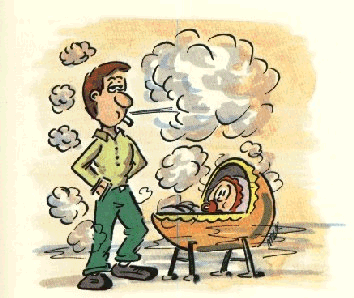
Smoking Ban


I've decided to get a little more "personal" and/or opinionated in my blog entries... at least once in a while anyway.

Before I get to abortion issues, I figured I should start with something slightly more benign in smoking bans.

The city of Madison, WI recently instituted a smoking ban. I am not knowledgeable of the financial ramifications of such a decision, nor do I care very much at this time. I'm not sure how it affects taxes or tax-funded services or programs, so this is not an entry about that.

I am happy that I can now to eat anywhere in Madison for lunch or dinner and not have to worry about my kids inhaling smoke, inhaling smoke myself, or walking out smelling like an ashtray. I live in a community that is not smoke free. Yet. Hopefully.
Playing devil's advocate, someone once asked me, "Don't smoker's have rights too?" I answered, "Yes." They have rights. They have the right to smoke. They have the right to go out to eat or drink too. But they don't have the right to hurt anyone or damage their health. Does anyone ever have the right to do something that can hurt others? I don't think so - or at least I don't think they have the right to.
Now, if establishments could successfully keep the smoke in the smoking section and out of the non-smoking section, I think that would be a fine compromise. I'm guessing that would require some remodeling, adding some walls and ventilation systems; but at least they'd have that option - that way, financially, they could still serve customers who want to smoke and those who do not. Otherwise, people who smoke can at least still eat without smoking. Its not like the city is banning the people - they are just banning the harmful behavior.
You can't fight in a bar or restaurant either. That doesn't mean that those people couldn't come in if they don't fight - its just that they can't behave harmfully while they are inside.
Thoughts?

Wednesday, February 4, 2009

Who Am I?

I was walking into work last week, and for some reason I was thinking about how the average job interview process is lame - for the most part. How does someone describe themselves? "Tell me about yourself." "What are your strengths and weaknesses." Etc, etc. I don't think it is possible to say "who you are." A description of "who I am" is like describing a photograph: its static. I can vaguely describe my appearance in terms of measurements and colors and ideas of relativity, but how does one accurately describe "who they are"?
"WHO I AM" isn't consistent. Who I am changes. It is not static. I can maybe tell you about who I was or who I want to be, but not who I am. Unless you want me to tell you who I am right this second. I can do that. But that won't do you, or I, or anyone else any good two second from now. My point is, who I am changes every day as I take on new knowledge and experiences. Who I am also changes, to a certain extent, based on my environment or situation.
One could argue that we are the same person no matter where we are - and I can see that argument - but I'm talking more about the outward behavior part of who I am. In other words, the part that people see. Call it the part that would make you decide if you would want to be my friend or not. For example, even though I am the same person everywhere, I am different at church than I am at a bar on New Years Eve. I don't mean to suggest that I have dissociative identity disorder (DID, f/k/a Multiple Personality Disorder), just that the context/situation I am in somewhat dictates how I behave.
This reminds me of the Nature vs. Nurture debate: are we who we are? Or are we 'trained' to be a certain way? Are we strongly influenced by our environment. For those of you who took Psychology 101, you may remember the similar debate about personality traits. The "Big 5" personality traits are Openness, Conscientiousness, Extraversion, Agreeableness, and Neuroticism. These have been analyzed, studied, and debated for years, but have held up remarkably well in our disposable world. Take each of the big five:
Openness: would I be as OPEN in a job interview as I would be with my best friend of 40 years?
Conscientiousness: would I be as conscientious with my brother as I would be on a third date with a woman I really liked?
Extraversion: would I be as extraverted in line at the DMV as I would at my 21st birthday party?
Abreeableness: would I be as agreeable in divorce court as I would be on my wedding day?
I would answer "NO" quite emphatically to each of those questions; I don't know about you.
So, I am assuming at this point we can agree that "personality" - at least to a certain extent - can change based on situations or context. Included in that - and where I'm heading - is the area of context that includes people. Let me explain:
I think specifically which people we are with, more than any other factor of context, determines our behavior - our personality - more than any other factor, such as time, location, etc, etc. Who am I with? Who is around me? Who am I interacting with? If I am a soldier in Iraq, I would probably act much differently with my comrades in the middle of the desert than in the middle of town, because there are other people present. Or even the same town at night versus during the middle of the day when people are walking around. Many of the environmental factors may have changed, yet its the people that would most affect my behavior.
Who I am is not something necessarily within me - at least operationally speaking. I (and therefore you) cannot "measure" who I am within my own head. I may be able to think it or say it, but until it is exihibited, it just isn't. It doesn't exist. It cannot be measureable. Further, who I am is only measureable by some other person. Its relative and relational. Read that again: RELATIVE and RELATIONAL. Look at the BIG FIVE personality traist above again. ALL FIVE are relational and relative. I would include other so-called personality traits like honesty, trustworthyness, funny, caring, etc, etc to be the same.
RELATIONAL:
Relational, to me, means that each of the personality traits cannot be experienced in a vacuum by myself. I cannot be agreeable to myself. I cannot be open to experiencing myself, because I am me. I cannot be dishonest to myself, because I know what I know. All of these traits must include another person. They can only be measured as they are exhibited within a relationship. They ARE the relationship.
RELATIVE:
Relative, because they are all abstract terms without measurement. Of course you could measure the percentage of time someone is honest versus not honest - or you could try - but there is no absolute scale for conscientiousness or neuroticism. All of the traits are on open ended spectrums with no set endpoints or even relative range. The relativity comes from our personal experience, meaning Person A is more agreeable than Person B. Person C is less extroverted than Person D. We continue to place people on multiple spectrums all based on our experience. But since our experiences/pasts are different, "WHO I AM" is going to be different to everyone since everyones' spectrums are different.
One of my favorite person examples of this is from college - though the same can be said for bosses at work or friends of friends: when scheduling classes for the upcoming semester, I would have acquaintences that would compare courses and professors. I often heard a phrase like, "Ooh. Don't take that professor, he/she's really tough/mean/bad/dumb/[insert favorite negative personality trait here]." More often than not (roughly 100% of the time), those professors were my favorite professor of that semester. There is a lot to be said for that - many different variables and factors - but my point is, how can I base my opinion of anyone on a third party's opinion? Or rather, how should I? Or even better, why would I? when I know that personalities are relational and relative. Who someone is to me will be much different that who someone is to another person. Our "relationship" - which is what I call that space "between" two people - is unique to those two people. Its a constant give and take of information/communication/behavior. Its a "dance", if you will.
So, who am I? You may all call me Ryan, but I am somebody different to each one of you. I am who I am to you. And you are who you are to me. We are.... we.

Friday, November 28, 2008

Social Recontruct?


Like many others, I have been thinking a lot about the economy lately. The the inquisitive junkie I am, I wonder how we got here, what the systemic effects are, and how we can get out of it. Since there are so many people, companies, countries, factors involved, it is a very complex system. Basically, "THE economy" is a term that encompasses so much more than most people give it credit for. Gregory Bateson has a phrase, "The name is not the thing named." This is perfect for the name "economy" because the current economy includes basically every person in the world that has ever lived and any financial interaction they have ever had that has led us to this point. How does anyone analyze today's "global economy"??? You can't. Not effectively anyway. Sure, you can tell me how much is being spent and where its coming from and where its going, but those are fairly static numbers. Just because someone may be able to throw out some data doesn't mean anyone could really understand it. To understand it would be to understand everything from individuals to groups to cultures to nations to continents to the world and how each of those different subunits interact. No offense, but few economists can probably make that claim. Even a very capable group of economists, systemicists, anthropologists, and psychologists would have a hard time truly understanding the world economy - and that would have to be a very large group in order to understand each culture.
Sure, you can study the U.S., China, Japan, and Europe and get a pretty good idea, but not a complete idea.
I've completely digressed.... my point is, whether we understand it or not, the economy is fucked - especially in the U.S. - and I'm kind of glad. We (America) needed a good housecleaning. Things have been spiraling out of control. I recently saw a graph that showed house prices over the past 100 or so years (that accounted for inflation) - it showed how housing prices have dramatically increased over the last 10-20 years. Look at professional athlete's and movie star and music star salaries!!! Talk about inflation! 50 years ago, professional football players were working labor jobs in the off-season to supplement their football pay. Now, elite players are turning down $10Mil/year offers! WTF? Some people pay $100 for a game ticket and complain about a $6.00 beer and $3.00 soda even though those beer and soda companies pay for the commercial spots that pay the league/teams that pay those prima donna players we complain about.
I'm very interested to see how this recession will affect those things that have escalated out of control. I've already seen how it has affected the housing market. House values have decreased and houses are hard to sell. But, if people are collectively purchasing less cars, beer, soda, diamonds, and investing less money with investors, then will those companies be able to pay as much for commercial spots during sporting events? Or, similarly, if stadiums cannot fill seats because ticket prices are too high, will they be forced to lower the price? If commercial spot and ticket prices are lowered, will leagues/teams be able to pay their players as much?
Society won't make change - at least drastic changes - unless it has to. Today's economy, educational system, media, criminal justice system have all developed into what we know today over a long period of very subtle changes. Who's to say the way they are structured now is the best way? Few would argue that our educational system is the best it can get. But as long as the people at the top (i.e., the people that profit) are making money, they sure as hell aren't going to change anything, at least drastically, that may cause them to not make money any more. But if the economy were to crash completely, then "we" could build up our institutions from the ground up the way that makes sense in today's world. I liken it to a wildfire: yes, they are destructive and wipe away almost everything in existence, but after they are done, a stronger, healthier system grows out of it. Like a cleansing. The world could use a cleansing right about now. What a different world it would be if teachers, religious leaders, stay-at-home mothers, non-profit leaders, food pantry operators, etc were paid as much as athletes and athletes were playing sports for fun instead of millions of dollars. Would that drastic of a change really change the fabric of our society? Perhaps, but perhaps for the better.